EMT Practice Test

1. Question Content...


Question List

Question1: Which of the following supports the need to govern Enterprise Architecture?

Question2: Exhibit.

Consider the diagram of an architecture development cycle.
Select the correct phase names corresponding to the labels 1, 2 and 3?

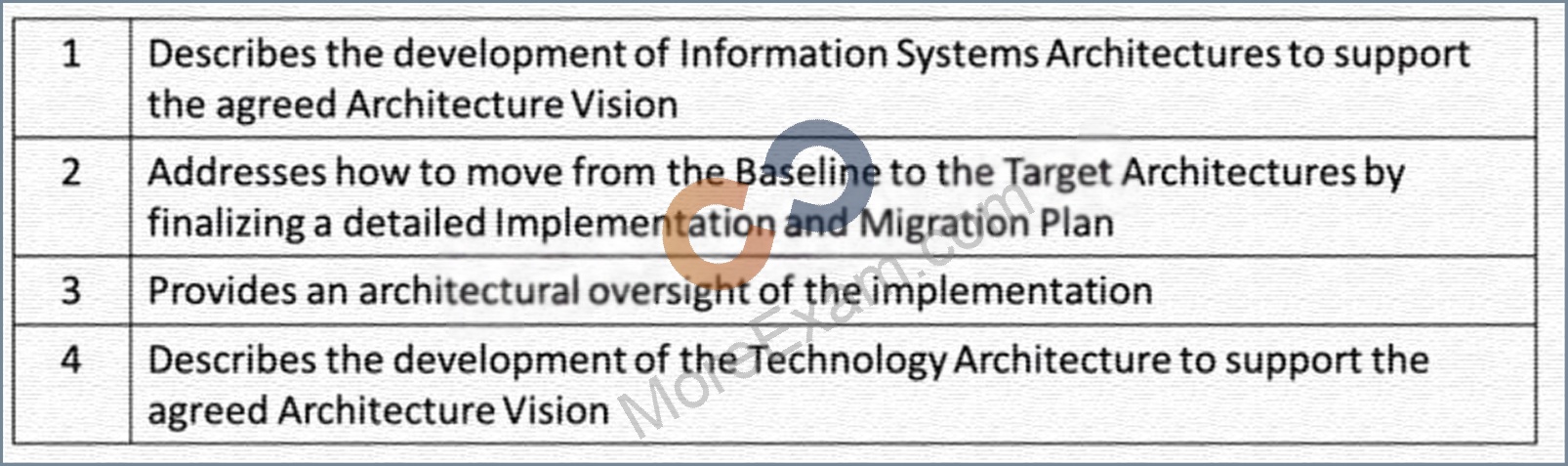
Question3: Consider the diagram of an architecture development cycle.
Which description matches the phase of the ADM labeled as item 1?

Question4: Question: Which ADM Phases match the following purpose descriptions?
Question5: Which of the following is a benefit of developing a TOGAF business scenario?

Question6: Which of the following is a benefit of organization mapping?

Question7: Consider the following statements;
1. A whole corporation or a division of a corporation
2. A government agency or a single government department
3. Partnerships and alliances of businesses working together, such as a consortium or supply chain What are those examples of according to the TOGAF Standard?

Question8: In what TOGAF ADM phase is the information map linked to other business blueprints?

Question9: Which ADM phase focuses on defining the problem to be solved, identifying the stakeholders, their concerns, and requirements?

Question10: When developing a Business Architecture, which of the following is recommended if an enterprise has existing Architecture Descriptions?

Question11: Where are business scenarios used most prominently in the TOGAF ADM?

Question12: Which of the following is the element of a value stream stage that describes the end state condition denoting the completion of the value stream stage?

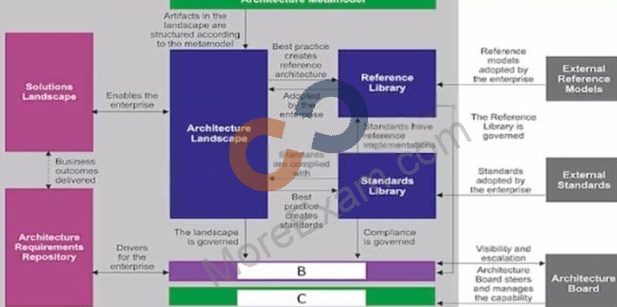
Question13: In the diagram, what are the items labelled A, B, and C?
Question14: Which of the following is a benefit of organization mapping?

Question15: What Business Architecture concept is most related to an information Map?

Question16: Complete the sentence A business capability is_________________________________.

Question17: Which of the following can be used to help define information concepts in an information map?

Question18: Complete the sentence. A key principle of value streams is that value is always defined from the perspective of the_____________

Question19: Which of the following best describes the relationship between business models and business architecture?

Question20: Consider the following:
In Phase A a business capability map and a core set of value streams were created while developing the Architecture Vision.
Why would such Architecture Descriptions need to be updated in Phase B?

Question21: Which of the following lists the components of a business capability?
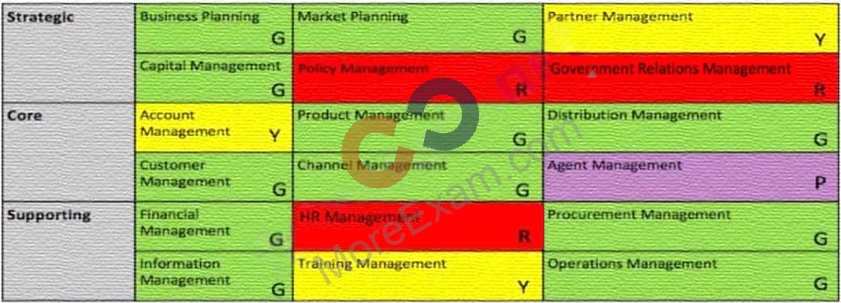
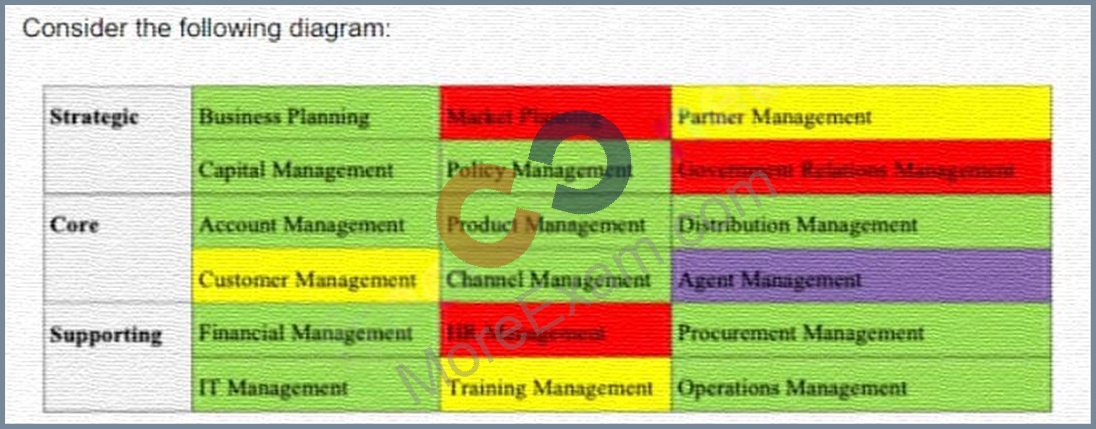
Question22: Consider the following business capability map. where cells of a model are given different colors to represent desired maturity levels (Green (G) = level achieved, yellow (Y) = one level away, red (R) =two or more levels away, purple (P) = missing capability):

Which of the following best describes what this shows?

Question23: Consider the following example value stream:

What does this show?

Question24: What information does the Architecture Requirements Repository within the Architecture Repository hold?

Question25: Which approach to model, measure, and analyze business value is primarily concerned with identifying the participants involved in creating and delivering value?

Question26: Consider the diagram of an architecture development cycle.
Which description matches the phase of the ADM labeled as item 2?

Question27: Which of the following describes how the Enterprise Continuum is used when developing an enterprise architecture?

Question28: Which of the following is the element of a value stream stage that describes the state change that triggers the value stream stage?

Question29: Consider the following example using the Business Model Canvas:

What are the segments labeled A, D and I?

Question30: Which statement best describes iteration and the ADM?

Question31: Consider the following graphic illustrating a method supporting the TOGAF ADM.

What does the method help identify?

Question32:
Which of the following best describes this diagram?

Question33: Which of the following is an analysis technique which is used to show a range of different perspectives on the same set of business capabilities?

Question34: Which of the following is an analysis technique which is used to show a range of different perspectives on the same set of business capabilities?

Question35: When developing a Business Architecture, which of the following best describes the approach to take If no Architecture Descriptions exist?

Question36: In what TOGAF ADM phase should the architect locate existing architecture descriptions to create an information map?

Question37: Consider the following Business Capability Example:
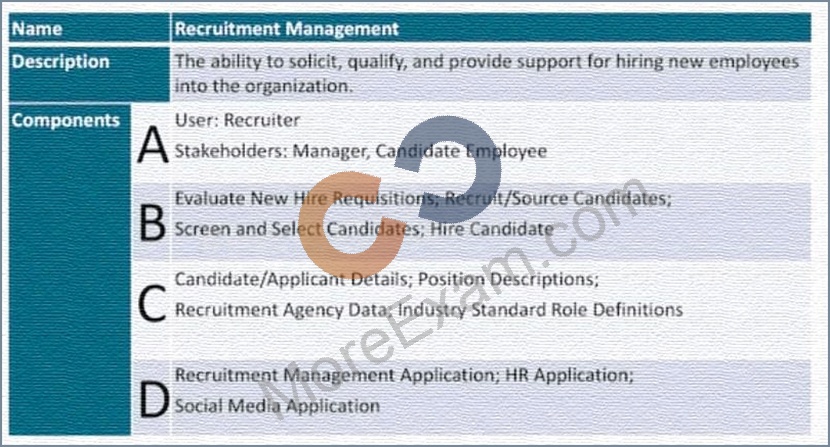
Which of the following are A and C?

Question38: Please consider the following statement.
They govern the architecture process, affecting the development, maintenance, and use of the Enterprise Architecture.
What does this describe?

Question39: What process is used to decompose a set of business capabilities to communicate more detail?

Question40: Which of the following best describes information mapping?

Question41: Which of the following is a benefit of information mapping?

Question42: Complete the sentence. A business model is a description of the rationale for how an organization creates, delivers, and captures

Question43: Which of the following is guidance for creating value streams?
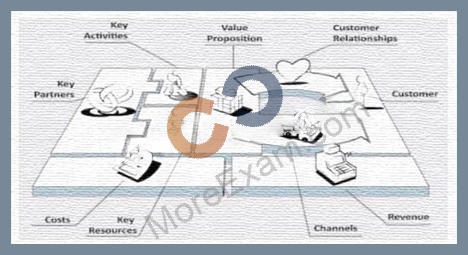
Question44: Consider the following representation of a business model:

Which of the following business models is this an example of?

Question45: What component of the Architecture Repository is an architectural representation of SBBs supporting the Architecture Landscape?

Question46: Complete the sentence An information map is a_______________________________________.